Before Malaysia's budget pays for a single service, RM210 billion of it is already spent
Two of the government's own documents give different totals for 2026. Both are right. Here is where the money goes, in order of size.
Receipt 02Fiscal Outlook 2026, Section 3 — Federal Government Expenditure
RM210.5bn
pay, interest and pensions in the 2026 operating budget
of RM338.2bn operating spending in all
Receipts — what this piece rests on
There is no named author on this piece. The documents above are the byline — check them.
“Can we do proper auditing of money allocated and how much does the people benefited?”
A viewer asked this under a video about the federal budget, and 26 people upvoted it:
Can we do proper auditing of money allocated and how much does the people benefited?
The second half of that question is genuinely hard. The first half is not — the allocation is published, in full, every year, in documents anyone can download. So we downloaded them and read them.
The first thing you find is that the government publishes two different totals for the same budget.
Two documents, two totals, and both are correct
The Ministry of Finance's Estimates of Federal Expenditure 2026 says the 2026 federal budget is RM421,202,000,000.
The Ministry of Finance's Fiscal Outlook 2026, published alongside it, says RM419.2 billion.
The gap is RM2 billion exactly, and it is not an error. The Estimates include a line called Simpanan Luar Jangka — a contingency reserve of RM2 billion. The Fiscal Outlook's figure carries a footnote saying it is a budget estimate excluding Budget 2026 measures, and it leaves the reserve out. Take the reserve off the Estimates total and you get RM419.2 billion precisely. Development spending reconciles the same way: RM83 billion including the reserve, RM81 billion without it.
Anggaran Perbelanjaan Persekutuan 2026 (Estimates of Federal Expenditure)
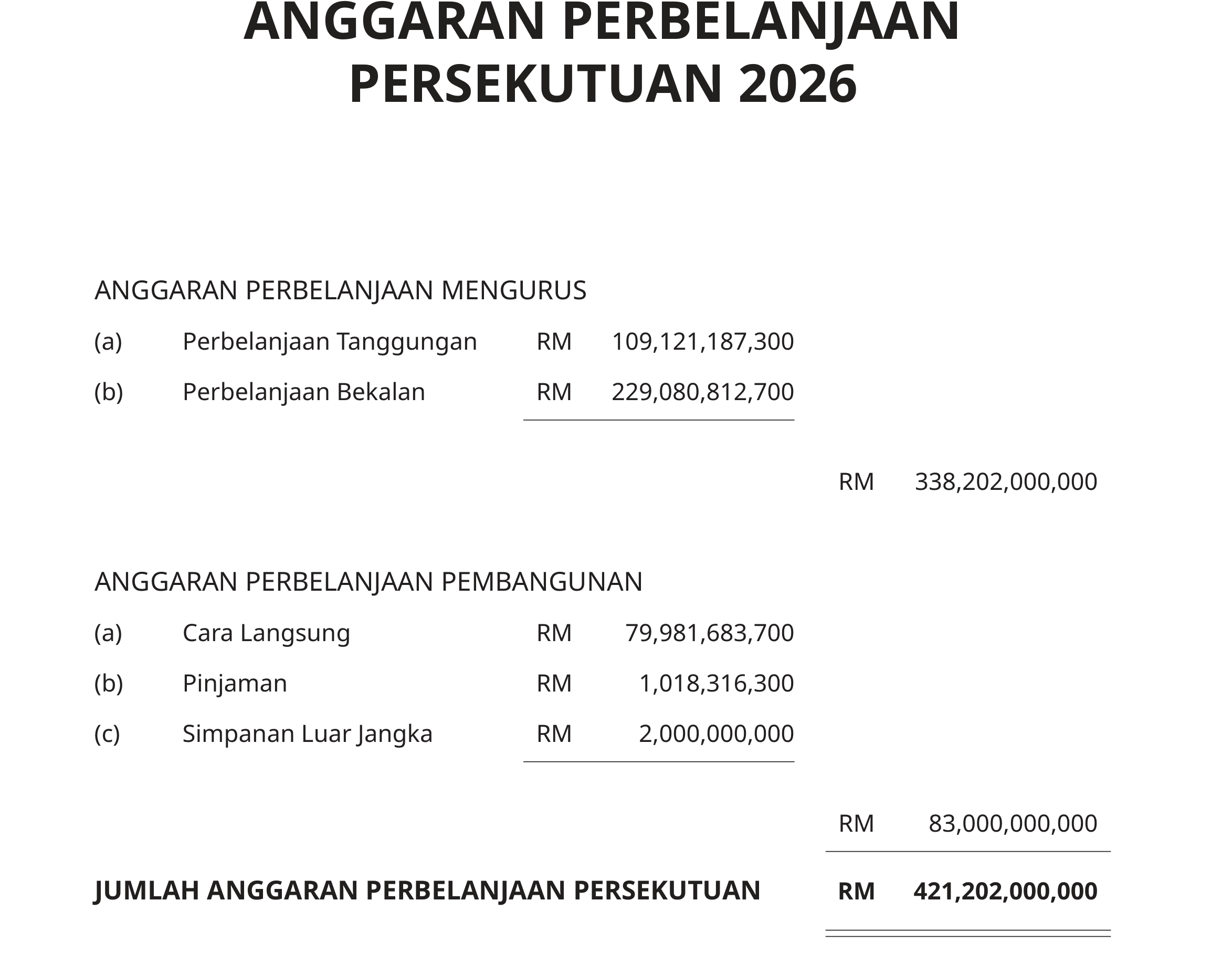
“Simpanan Luar Jangka — RM 2,000,000,000. The contingency reserve is the whole of the difference between the government's two published totals.”
This is the first practical answer to the question. Both numbers are official, both are right, and you can only tell which one someone is using by opening both documents. A figure being from a primary source is not the end of verification.
There is a second trap sitting next to it. "RM421 billion" refers to two different things in two consecutive years. The 2025 budget was approved at RM421.0 billion and then revised down during the year to RM412.1 billion. The 2026 budget is estimated at RM421.202 billion. A sentence that says "RM421 billion" without naming the year and whether it is an approved allocation, a revised figure or an estimate is wrong about half the time, and it looks perfectly sourced either way.
Where the money actually goes
Malaysia's federal spending splits into two buckets. Operating expenditure — RM338.2 billion, 15.9% of GDP — is the cost of running the country. Development expenditure — RM81 billion, 3.8% of GDP — is the cost of building things. Operating is 80.7% of the budget. Development is 19.3%.
Inside the operating budget, this is the order of size.
Where a ringgit of Malaysia's 2026 operating budget goes
The top bar is emoluments — RM109.4 billion, the public-service pay bill, and it is 32.3% of operating spending on its own. It has risen from RM95.9 billion in 2024, which the Ministry attributes to the new public-service remuneration system implemented in December 2024.
The second is debt service charges — RM58.3 billion. That is interest on money already borrowed.
The fourth is retirement charges — RM42.8 billion, pensions for former public servants. The Ministry notes the number of pensioners and beneficiaries "is now approaching one million recipients", and that the government is finalising a defined-contribution scheme to replace the defined-benefit pension for new public servants, to be administered by EPF.
Add those three together — pay, interest, pensions — and you get RM210.5 billion, or 62.2% of the entire operating budget.
Fiscal Outlook 2026, Section 3 — Federal Government Expenditure
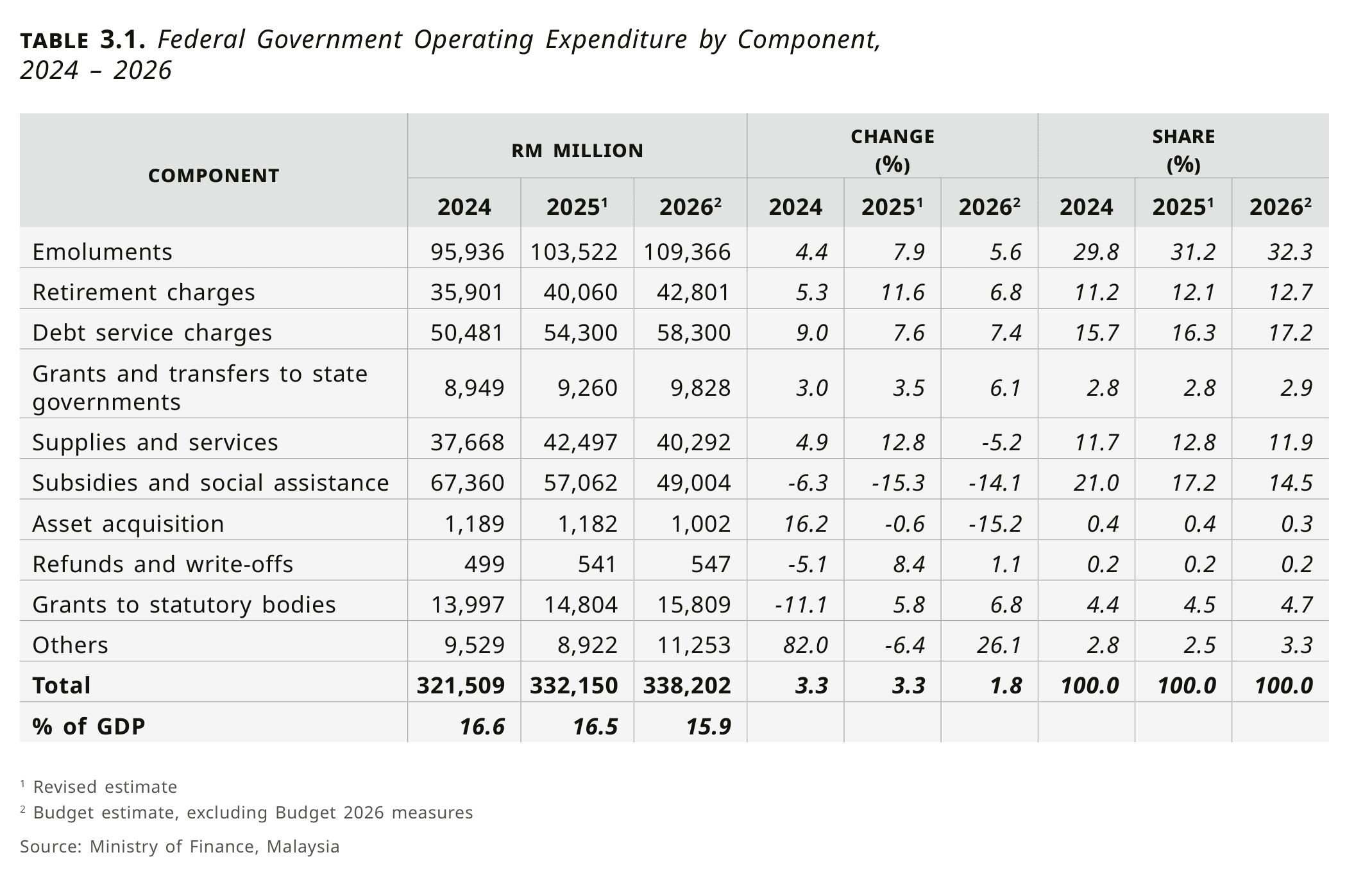
“Emoluments 109,366 · Debt service charges 58,300 · Retirement charges 42,801. Three rows, RM210.5 billion of the RM338.2 billion total.”
That is money committed before a single hospital opens, a single class is taught or a single road is repaired. It is not waste; salaries and pensions are what a public service is, and interest is the price of past borrowing. But it is the reason the budget feels immovable, and it is the honest starting point for any argument about what the government could spend differently.
The part Parliament does not vote on each year
The Estimates split spending a second way, and this is the split that speaks most directly to the question about auditing.
RM109,121,187,300 is classed as Perbelanjaan Tanggungan — charged expenditure. That is 25.9% of the total budget. Charged expenditure is money the Federal Constitution and various Acts charge directly on the Consolidated Fund: debt service, pensions, constitutional office-holders' salaries, transfers the constitution mandates. It is spent because the law says so, not because Parliament approves that line this year.
The remaining RM229,080,812,700 is Perbelanjaan Bekalan — supply expenditure, which is what Parliament actually votes on, ministry by ministry.
So roughly one ringgit in four of federal spending is not put to an annual vote at all. Anyone asking whether the allocation can be audited should know that a quarter of it is settled before the debate starts.
You can see the same thing from the sector view. The Ministry breaks the RM419.2 billion into social, economic, security and general administration — and then reports that 33.2%, RM139.2 billion, sits outside all four, under charged expenditure and transfer payments.
Total federal spending by sector, 2026
The social sector is the largest single claim on the budget at RM155.9 billion, 37.2%. But the second-largest bar on that chart is not a service at all.
The biggest thing that changed
One line has moved far more than any other.
Subsidies and social assistance, 2024 to 2026
Subsidies and social assistance have fallen from RM67.4 billion in 2024 to RM49.0 billion in 2026 — down RM18.4 billion, a 27% cut in two years. The Ministry gives the reasons: fuel subsidy rationalisation and lower global oil prices, the retargeting of the diesel subsidy, which it says curbed smuggling and saved up to RM600 million a month, the end of the blanket subsidy for chicken eggs in August 2025, and the BUDI95 targeted RON95 scheme.
Set against that, emoluments rose RM13.4 billion over the same two years. The largest saving in the budget and the largest increase in the budget are close to the same size. Whether that is the right trade is a political question, not one the documents answer, but it is the trade that was made, and it is legible in one table.
Who does receive the fuel subsidy, in ringgit, by income group, is a separate question with its own household data behind it. We will take that one on its own.
What the RM81 billion builds
Development spending is the part that produces something new, and it is under a fifth of the budget. Its economic sector takes RM36.8 billion (45.4%), of which transport alone is RM17.5 billion; social takes RM28.6 billion (35.3%), of which education and training is RM14.5 billion and health RM7.0 billion; security RM11.7 billion; general administration RM3.9 billion.
Fiscal Outlook 2026, Section 3 — Federal Government Expenditure
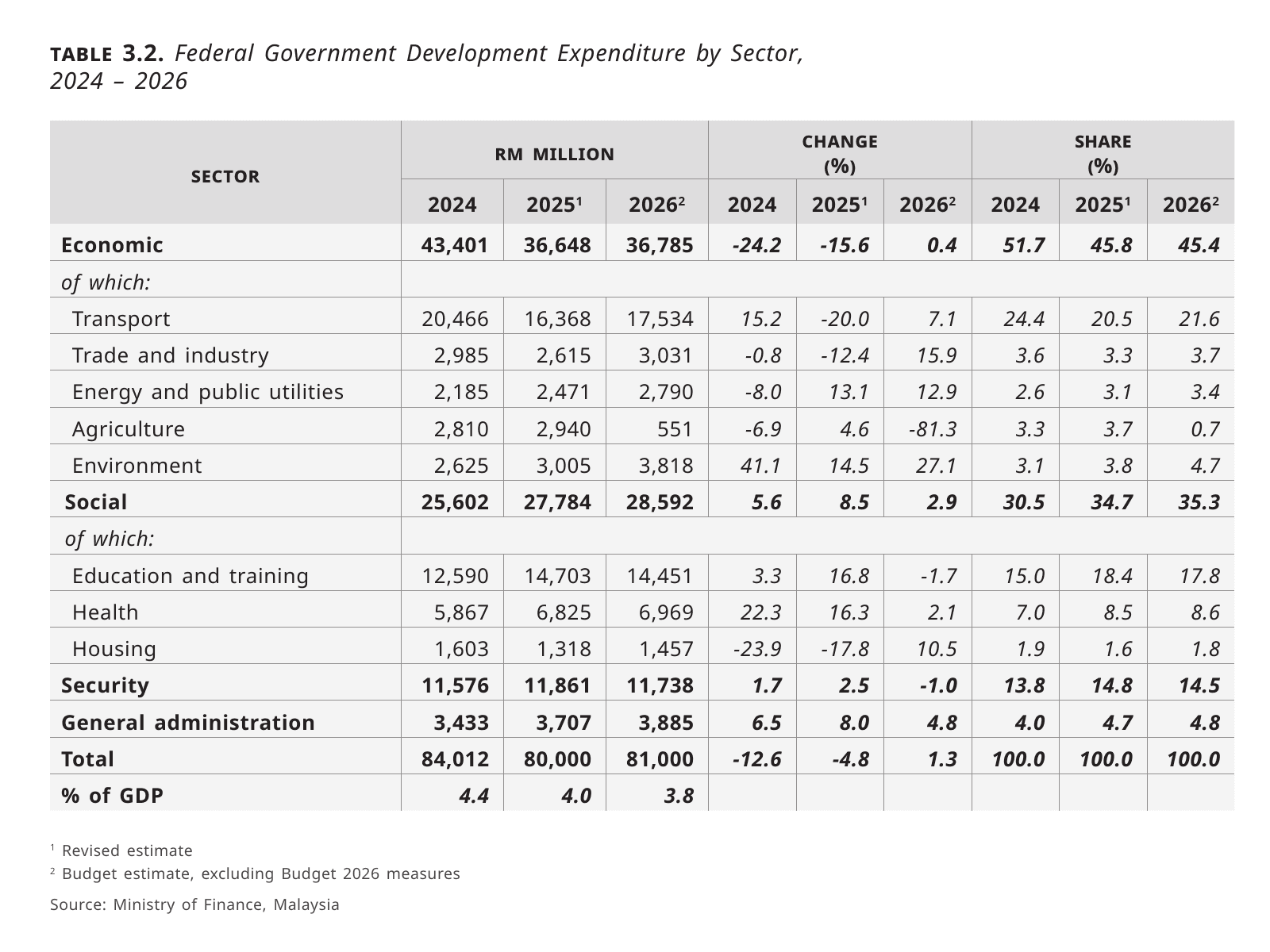
“Total 84,012 80,000 81,000”
The Ministry notes that 2026 is the first year of the Thirteenth Malaysia Plan and that development spending is required by the Public Finance and Fiscal Responsibility Act 2023 to be at least 3% of GDP. At 3.8%, it clears that floor.
Two other lines are worth knowing because they are large and rarely mentioned. Grants to statutory bodies are RM15.8 billion, and the Ministry says 69.4% of that goes to 20 public universities and nine teaching hospitals. Grants and transfers to state governments are RM9.8 billion, of which RM7.7 billion is constitutional transfers, with Sabah and Sarawak named as the main recipients — though the document does not publish the split between states.
Fiscal Outlook 2026, Section 3 — Federal Government Expenditure
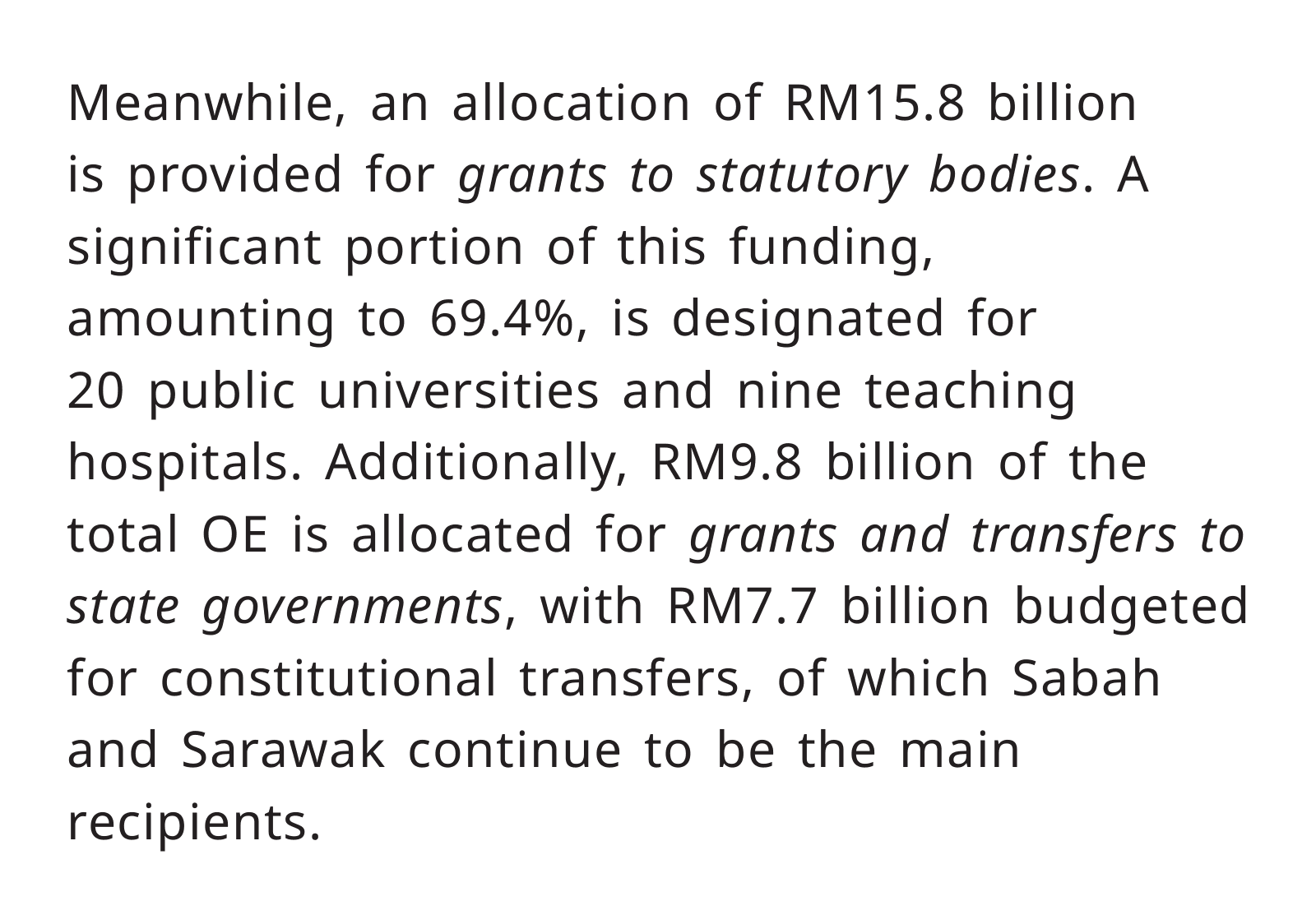
“A significant portion of this funding, amounting to 69.4%, is designated for 20 public universities and nine teaching hospitals.”
The honest answer
The money allocated can be audited, in the sense the question means: it is published, itemised, and the arithmetic in the tables is internally consistent — we checked every column against its printed total and they reconcile exactly.
What the documents will not tell you is the second half of the question, how much the people benefited. Allocation is not outcome. The Estimates say RM109.4 billion goes to salaries; they do not say what was delivered for it. That gap is what the Auditor-General's reports and the Public Accounts Committee exist to fill, and it is where this cell goes next.
But three things are answerable now, and all three are in the tables:
Sixty-two sen of every ringgit of operating spending is pay, pensions and interest. A quarter of the whole budget is charged expenditure that Parliament does not vote on annually. And under a fifth of it builds anything.
None of that requires a leak, a source or an allegation. It requires opening two PDFs that have been sitting on a government website since budget day.
Notes on the figures. All 2026 figures are budget estimates; 2025 figures are revised estimates; 2024 figures are actuals. Where a total is quoted as RM419.2 billion it excludes the RM2 billion contingency reserve, and where it is quoted as RM421.202 billion it includes it — the two bases are never mixed within a comparison here. Percentage figures for the operating budget are shares of RM338.2 billion; sector shares are of RM419.2 billion. The 62.2% and 25.9% figures are our own arithmetic on the Ministry's published values, as is the RM18.4 billion two-year fall in subsidies. The Ministry's own printed share for the "Others" line (2.8% in 2024, 2.5% in 2025) is a rounding residue that makes each column total exactly 100.0; computed from the ringgit values it is 3.0% and 2.7%, so we have used the ringgit figures rather than that share throughout.
Not verified. The split of the RM7.7 billion in constitutional transfers between Sabah, Sarawak and the other states — the Ministry names them as the main recipients but publishes no per-state figure in this document. The RM551 million 2026 allocation for the agriculture subsector, down 81.3% from RM2.94 billion, is printed in Table 3.2 but the document gives no explanation for a fall that large, and we do not assume one.
Get the next one
Related, by subject
The median Malaysian citizen's pay rose to RM2,793 in 2024. It buys what RM2,103 bought in 2010.
Malaysia's median citizen earned RM2,793 a month in 2024. Measured in 2010 ringgit it was RM2,103. Both figures are DOSM's own.
The ringgit did get stronger — against eleven of fourteen currencies. The Singapore dollar was not one of them.
Bank Negara's own daily rate table, 2015 to 2025: what the ringgit did against fourteen currencies, and why the start date decides the answer.
Only one of Malaysia's oil states is rich on paper. It's the one whose households aren't.
Sarawak produces 29% more per person than the national average and earns 22% less per household. Sabah and Terengganu don't fit the pattern at all.